the transformative drug
The transformative drug is the chemical compound created by Henry Jekyll that enables his physical and moral transformation into Edward Hyde, serving as the central mechanism of the novel's plot and the embodiment of its exploration of human duality. It is a potion composed of a particular salt and a blood-red tincture, whose precise formula Jekyll discovers through his scientific studies directed toward the mystic and transcendental. The drug does not discriminate between good and evil; it merely shakes the doors of the prisonhouse of disposition, allowing whatever stands within to run forth. Its creation and repeated use drive the narrative, leading to Jekyll's eventual loss of control and tragic end.
Composition and Preparation
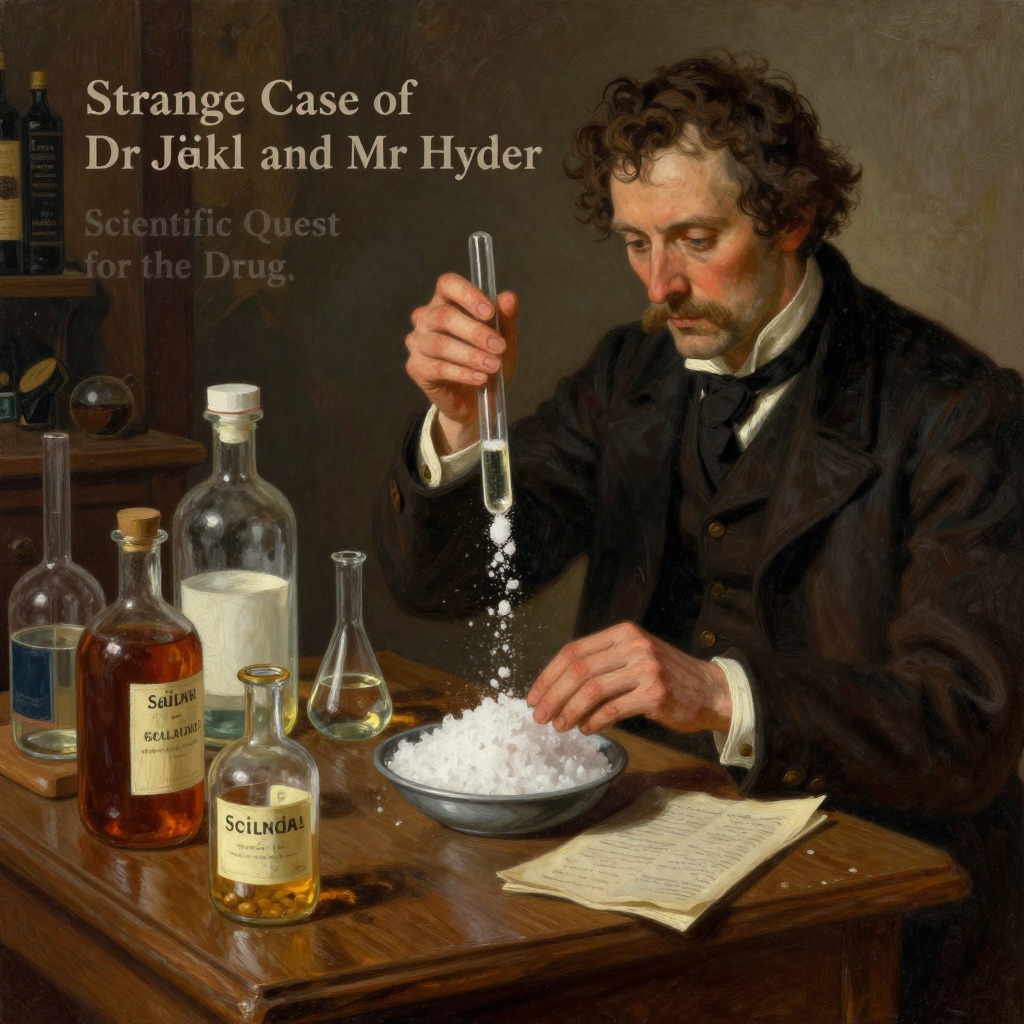
The drug consists of two main components: a white crystalline salt and a blood-red liquor. The salt, which Jekyll purchases in large quantity from a firm of wholesale chemists, is a simple crystalline substance of his own private manufacture, not made with the nicety of a dispensing chemist. The tincture, about half full in a phial, is highly pungent to the sense of smell and appears to contain phosphorus and some volatile ether, with other ingredients that Lanyon could not guess. When mixed, the compound undergoes a series of visible changes: it begins with a reddish hue, brightens as the crystals melt, effervesces audibly, throws off small fumes of vapor, then suddenly ceases ebullition and changes to a dark purple, which fades more slowly to a watery green. Jekyll prepares the drug in his cabinet, using a graduated glass to measure precise amounts, and the mixture must be drunk to effect the transformation.
First Use and Effects
Late one accursed night, Jekyll compounds the elements, watches them boil and smoke together in the glass, and drinks off the potion. The first effects are the most racking pangs: a grinding in the bones, deadly nausea, and a horror of the spirit that cannot be exceeded at the hour of birth or death. These agonies subside swiftly, and Jekyll comes to himself as if out of a great sickness, experiencing something indescribably new and incredibly sweet. He feels younger, lighter, happier in body, conscious of a heady recklessness, a current of disordered sensual images, a solution of the bonds of obligation, and an unknown but not innocent freedom of the soul. At the first breath of this new life, he knows himself to be more wicked, tenfold more wicked, sold a slave to his original evil, and the thought braces and delights him like wine. In the act of stretching out his hands, he becomes suddenly aware that he has lost in stature, and when he sees himself in a mirror, he beholds the appearance of Edward Hyde—smaller, slighter, younger, and bearing the imprint of deformity and decay.
Variability and Deterioration
The drug's power is not always equally displayed. Early in his career, it totally failed Jekyll once, and on more than one occasion he is obliged to double, and once with infinite risk of death to treble, the amount. These rare uncertainties cast the sole shadow on his contentment. Over time, the difficulty of transformation shifts: whereas in the beginning it was hard to throw off the body of Jekyll, it gradually but decidedly transfers to the other side, so that Jekyll slowly loses hold of his original and better self and becomes incorporated with his second and worse. After the murder of Sir Danvers Carew, Jekyll finds that the drug must be re-administered frequently; from that day forth, it seems only by a great effort as of gymnastics, and only under the immediate stimulation of the drug, that he can wear the countenance of Jekyll. At all hours, he is taken with premonitory shudders, and if he sleeps or even dozes for a moment, he awakens as Hyde. The pangs of transformation grow daily less marked, and the powers of Hyde seem to grow with the sickliness of Jekyll.
The Impurity and Final Failure
The drug's efficacy ultimately depends on an unknown impurity in the original supply of salt. Jekyll's provision of the salt, never renewed since the date of the first experiment, begins to run low. He sends out for a fresh supply and mixes the draught; the ebullition follows, and the first change of color, but not the second. He drinks it, and it is without efficiency. He has London ransacked by Poole, sending orders to all the wholesale chemists, but every sample brought back is rejected as impure, and he desperately begs for some of the old. He becomes persuaded that his first supply was impure and that it was that unknown impurity which lent efficacy to the draught. The last of the old powders is used to write his confession, and after that, no further transformation is possible, leaving Hyde to die by his own hand.
Narrative and Thematic Significance
The transformative drug is the engine of the plot, enabling the central duality of Jekyll and Hyde. It represents the attempt to separate the good and evil elements of human nature, a project that Jekyll pursues with scientific ambition but which ultimately proves disastrous. The drug's failure due to an impurity underscores the theme that the dual nature of man cannot be artificially divided; the attempt to cast off the burden of life only returns it with more unfamiliar and awful pressure. The drug also functions as a material object that, through its variability and eventual breakdown, reveals its own thing-power—it is not a passive tool but an active agent whose properties and limitations shape the course of events. Its composition, effects, and deterioration are meticulously documented in Jekyll's confession and Lanyon's narrative, providing the scientific and moral framework for the novel's exploration of identity, morality, and the limits of human knowledge.